

Claude Fable 5.2 vs 5.1: Briefing a Wooden Owl
Claude Fable 5.2 vs 5.1 for translating a clay owl into carved wood: compare material cues, silhouette, and a practical way to choose.
What's new on this page
- — Page published.
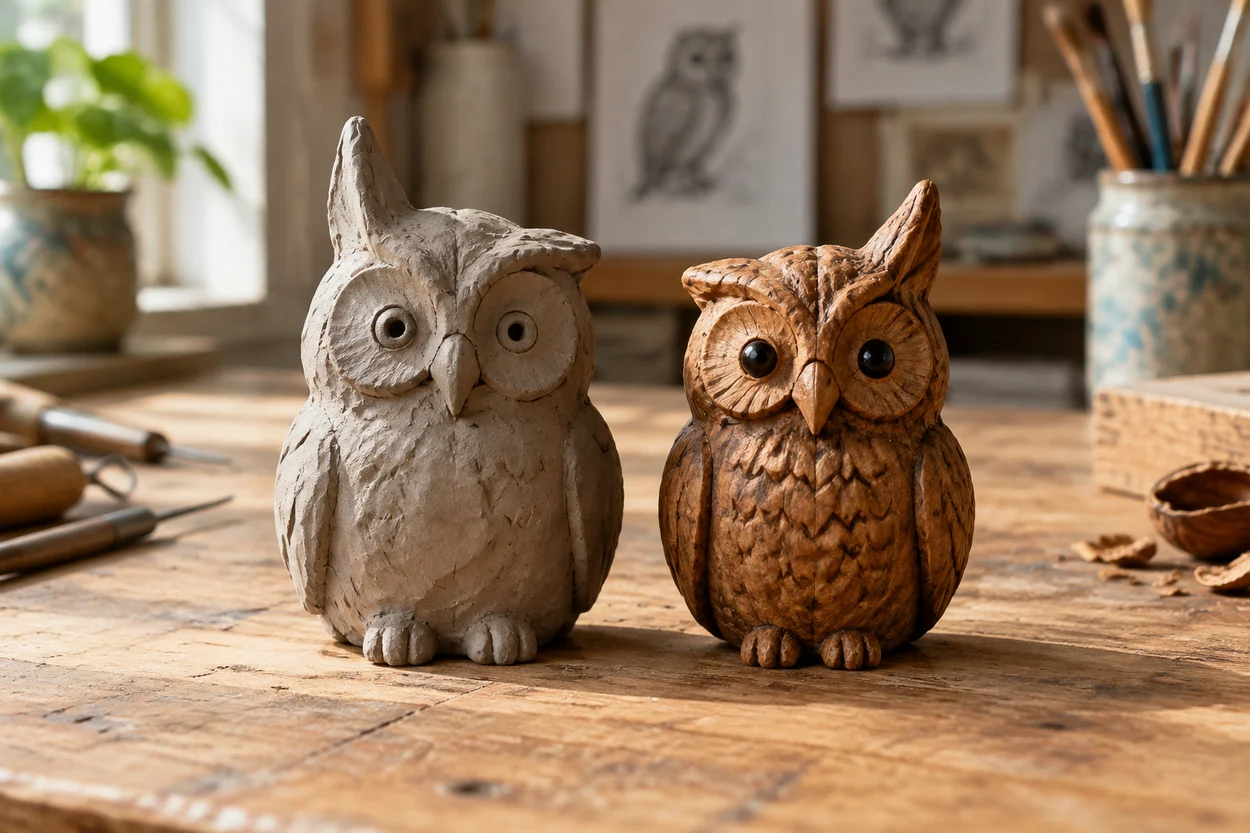
For an art teacher translating a clay owl into a small carved wooden sculpture, the important question in Claude Fable 5.2 vs 5.1 is not which version is universally better. It is which one gives you a more usable planning brief for the asymmetric ear, head tilt, and base. Try 5.2 when you want a fresh interpretation to weigh against your current instructions; keep 5.1 if its existing brief already preserves those features and changing models would add review work without solving a problem.
This comparison is about text planning. Either model can help draft or revise a description, but a separate image or video tool would create or process visual output. The brief below is a way to make the model’s decisions inspectable before you move on to another tool or to the workshop.
Set the translation problem
Assume the clay owl is about palm-high. One ear is noticeably shorter and slightly chipped; the head leans toward that side. The body is rounded but not symmetrical, and a low, irregular base keeps the figure stable. The goal is not a literal clay-to-wood material swap. It is a small carved object that reads as the same owl while looking plausible in wood.
Before comparing model drafts, separate what must stay from what may change. The three identity anchors are the unequal ears, the direction and amount of the head tilt, and the base’s outline and contact with the body. Wood grain, tool marks, and softened details are translation choices. This distinction matters because a model can produce fluent craft language while quietly regularizing the ear or straightening the head.
A silhouette check is especially useful. Imagine the owl as a solid dark cutout, with no eyes, feather marks, or grain. Can you still identify the short ear, the lean, and the base? If not, surface detail is distracting from a structural change. For a related visual-planning starting point, see AI sculpture filter; it is separate from the text-planning comparison here.
A copyable brief
Use the same instructions with both versions so that you compare their responses rather than two different prompts:
Task: Write a concise carving plan for translating my clay owl into a small wooden sculpture. Treat the following as fixed identity features: the left ear is shorter and chipped at the tip; the head tilts toward that ear; the low base is irregular and visibly joins the body. Do not mirror, level, equalize, or replace these features. Describe the front-view silhouette first, then explain which clay cues should become wood cues. Address grain direction, likely visual effects of carving, and details that should be simplified. Do not invent measurements or claim the object will be structurally safe. List any uncertainty as a question for me rather than resolving it by guessing. End with three checks I can use to compare a draft against the clay original.
If your sculpture has a different short-ear side, reverse the wording before running either version. Keep the order, fixed features, and requested checks the same. That makes the comparison fair and makes it easier to spot whether a difference comes from the model or from the brief.
Read the replies for silhouette and material
Start with the silhouette, not the prose polish. A useful answer should describe the shorter ear as shorter, preserve the tilt toward it, and retain the base as an irregular part of the figure. Look for relationships, not just a list of nouns: does the brief say where the head leans relative to the body and where the base meets it? “An owl with an asymmetrical ear” is weaker than a description that specifies which ear is short and how the lean relates to it.
Then inspect the material cues. Clay can suggest a continuous, soft surface; wood has visible grain and is shaped by cutting. A plan might say to keep the grain running through the body’s main mass, while avoiding a grain line or carved groove that visually divides the short ear from the head. It might distinguish shallow incised feather marks from deep cuts that would alter the outline. These are planning prompts, not guarantees about a particular wood species, tool, or structural result. If the answer names a species or makes a strength claim you did not provide, treat that as an unsupported assumption.
For example, hypothetical phrasing from a usable draft might read: “In front view, keep the left ear as the lower, chipped point and retain the head’s lean toward it; do not balance the ears. Let the grain follow the body’s upright mass, and use restrained, shallow feather cuts so the edges remain readable.” This is illustrative wording, not a claim about what either model will produce. It is useful because it links material treatment to silhouette instead of letting decorative texture take over.
A second hypothetical line could flag an open question: “The base’s exact underside is unclear; confirm its contact shape before proposing a carving sequence.” That is better than inventing a flat bottom or a hidden support. For a classroom exercise, mark each instruction as preserve, translate, or confirm. Preserve covers the three identity anchors; translate covers clay surface into wood treatment; confirm covers missing information.
Make the model choice operational
Give each draft a simple pass or fail on four checks: correct short-ear side, correct tilt direction, base retained as described, and at least one specific wood cue that does not erase the silhouette. Then use a tie-breaker: among drafts that pass all four, choose the one that states uncertainty rather than inventing a detail. If neither passes, revise the brief or add a front-view reference description and run again; do not select the more polished answer just because it sounds confident.
Try 5.2 when you want a second planning draft, are changing how you describe the wood, or need to test whether the brief makes the fixed features unmistakable. Keep your existing 5.1 workflow when its output already passes the checks, your class materials depend on a consistent prompt, or a new draft would require extra verification without a clear benefit. If the two versions both pass, use the tie-breaker above and retain whichever instructions are easiest for students to follow consistently.
Anthropic’s Claude Fable model-family page lists official rates of $8 per million input tokens and $40 per million output tokens for 5.2, compared with $10 and $50 for 5.1. Those rates can inform a separate cost decision, but they do not tell you which brief will better preserve an owl’s asymmetry. For this exercise, the decisive evidence is the draft’s silhouette description, its treatment of wood cues, and whether it admits what it does not know.